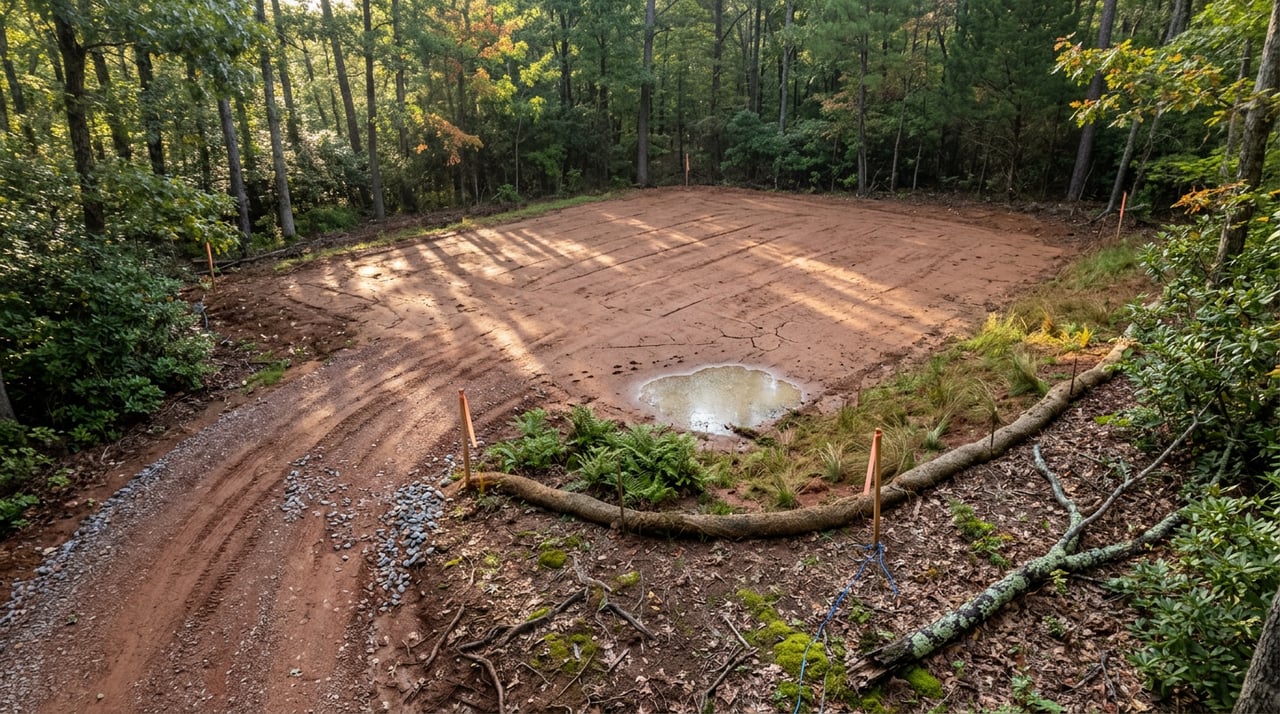
Buying Land in Whitwell, TN? The Price Per Acre Doesn't Tell You What's Under It
August 27, 2026
August 27, 2026
Walk into the Marion County Coal Miners Museum on Main Street in Whitwell and you'll likely meet a retired miner running the front desk. JT Shadrick founded the place after a dream convinced him his own collection of cap lamps and rail horses deserved a permanent home. The volunteers are mostly men who worked the same mountain the museum sits beside, and they'll tell you about the shift in 1981 when a methane explosion at Mine No. 21 took the lives of 13 men nearly five miles inside the mountain. It's a heavy story, told by people who lived it, and it explains something about this town that doesn't show up on any listing sheet.
Whitwell was Cheekville until Tennessee Coal, Iron and Railroad Company arrived in the 1880s and renamed it. For over a century, mining companies weren't just employers here. They were landowners, and when they eventually sold off surface tracts, plenty of them kept something back. That habit is still buried in local deeds today, and it's the reason a buyer looking at raw acreage in Whitwell needs to ask a question most land listings never answer: what exactly are you buying, the ground or everything under it too?
Tennessee law treats what's on top of your land and what's beneath it as two separate legal estates. You can own both, or you can own the surface while someone else, maybe a company that hasn't operated in this valley in decades, holds the rights to whatever minerals sit underneath. This isn't a loophole. It's settled Tennessee property law, upheld by the state's Supreme Court in Knoxville v. Bailey, which affirmed that mineral ownership is its own transferable interest, separate from the dirt itself.
The split happens through deed language, and the wording matters more than most buyers realize. A deed that reads "together with all minerals, oil, gas" passes everything to the buyer. One that says "excepting and reserving unto Grantor all mineral rights" keeps the minerals with the seller or their heirs, forever, unless someone later sells or abandons that interest. A third version, "subject to all leases, reservations, and easements of record," means an old mineral claim might already be sitting in the chain of title, silently attached to the land you're about to close on.
Tennessee doesn't even require a deed to mention minerals for the seller to keep them. Silence on the subject can still mean a severance happened somewhere upstream in the property's history.
Every rural county in Tennessee has some deeds with mineral reservations tucked into them. Whitwell has more reason than most. The Sequatchie Valley Railroad reached the town in 1887 specifically to haul coal to blast furnaces in South Pittsburg, and mining stayed the valley's dominant industry until the mines finally went bankrupt in 1996. That's well over a century of land changing hands through coal companies, timber outfits, and their successors, many of whom sold the surface while quietly holding onto what was underneath for possible future value.
A parcel that's been in one family since before the mines closed might carry a mineral reservation from a 1950s transaction that nobody living today remembers signing. A newer subdivision built after 1996 is far less likely to carry that baggage. The age and history of the specific tract matters more than the general reputation of the area, which is exactly why a title search that only checks the last owner isn't enough here.
Buyers often assume a title insurance policy protects them from every hidden defect in a property, including this one. It usually doesn't. Standard practice for title insurers is to exclude severed mineral interests from coverage entirely, with a specific exception written into Schedule B stating that oil, gas, and other minerals are not insured under the policy. Some underwriting guidelines go further, insuring only the "surface estate" by name, which makes clear from the start that whatever's below the topsoil isn't part of what you're protected on.
That's not a flaw in your title company's work. It's how the product is built. But it means the burden falls on you, or your agent, to ask the direct question before closing rather than assuming the policy has it covered.
None of this means walking away from a great piece of ground. It means walking in with your eyes open about which parts of it are actually yours.
Here's the part that should make a nervous buyer feel better rather than worse. When mineral rights are severed, Tennessee courts treat the mineral estate as dominant, meaning the mineral owner generally has the right to reasonable surface access if they ever decide to extract. But that dominance isn't unlimited. In Cowan v. Hardwick, Tennessee courts ruled that mineral owners can't engage in wasteful or negligent practices that damage the surface beyond what's reasonably necessary. The law leans toward extraction, but it doesn't hand a mineral owner a blank check to tear up your homesite.
More importantly, Tennessee gives surface owners a real path to reclaim minerals that were severed and then simply forgotten. The state legislature found that many mineral estates across Tennessee were separated from the surface generations ago, never registered properly, and sit unused and untaxed, creating what the law calls title uncertainty for the surface owner. Under Tennessee Code Annotated § 66-5-108, a surface owner can file a claim in chancery court showing no mineral tax has been paid and no use has been made of the mineral interest for the required period. If the mineral owner doesn't respond within 60 days after notice is published, a judge can rule the interest abandoned and reunite it with your surface title.
It's not instant and it's not free, but it's a real legal mechanism, not just a hope that nobody ever shows up wanting to drill under your new porch.
Here's the piece that changes how you should read a Whitwell listing. As of late June 2026, roughly three dozen rural land listings around Whitwell were averaging about $11,167 per acre. That figure gets quoted the same way whether the tract is a half-acre wooded lot on Mullins Cove Road facing the Tennessee River, a build-ready parcel along the Highway 28 corridor connecting Jasper, Whitwell, and Dunlap, or acreage tucked near Suck Creek and Prentice Cooper State Park. None of those listings price in whether the mineral rights travel with the sale.
That's the quiet problem with a per-acre average in a town like this one. Two parcels can carry the same price tag and be fundamentally different purchases, one where you own everything from the fence line down, and one where a piece of what's underneath still belongs to a coal company's successor that hasn't touched this valley in thirty years. The listing price won't tell you which one you're looking at. Only the deed will.
Does this only matter for big acreage, or could it affect a small building lot too? Reservations get recorded by legal description, not by tract size, so a small parcel carved out of a larger historic holding can carry the same mineral exception as the 300-acre tract next to it.
If I already own land here, can I find out whether my minerals were severed? Yes. A title abstractor or attorney can trace the recorded chain of title at the Register of Deeds and tell you definitively, and if the mineral interest looks abandoned, § 66-5-108 gives you a path to reclaim it.
Should I assume every older Whitwell property has severed minerals? No, but it's worth checking rather than assuming either way. Plenty of tracts changed hands cleanly. The point isn't fear, it's confirmation before you sign.
Whitwell's coal history isn't something to dodge around when you're buying land here. It's part of what makes the valley what it is, and understanding it actually makes you a sharper buyer, not a more anxious one. If you're looking at acreage in Whitwell or anywhere else in Marion County and want someone who'll walk the deed history with you before you fall in love with the view, Jessica Wright would love to help you sort out exactly what you're buying. Let's Connect.
Stay up to date on the latest real estate trends.
Let me help you explore your wants and dreams, from finding land to building your dream home to finding a house to make your home. I look forward to being part of that adventure with you.
JESSICA WRIGHT
338 S Cedar Ave
South Pittsburg, TN 37380
OFFICE HOURS
Monday to Saturday: 8:00 AM to 8:00 PM