Buying Waterfront Near Kimball, TN: What to Know About Transferring a TVA Dock Permit
September 24, 2026
September 24, 2026
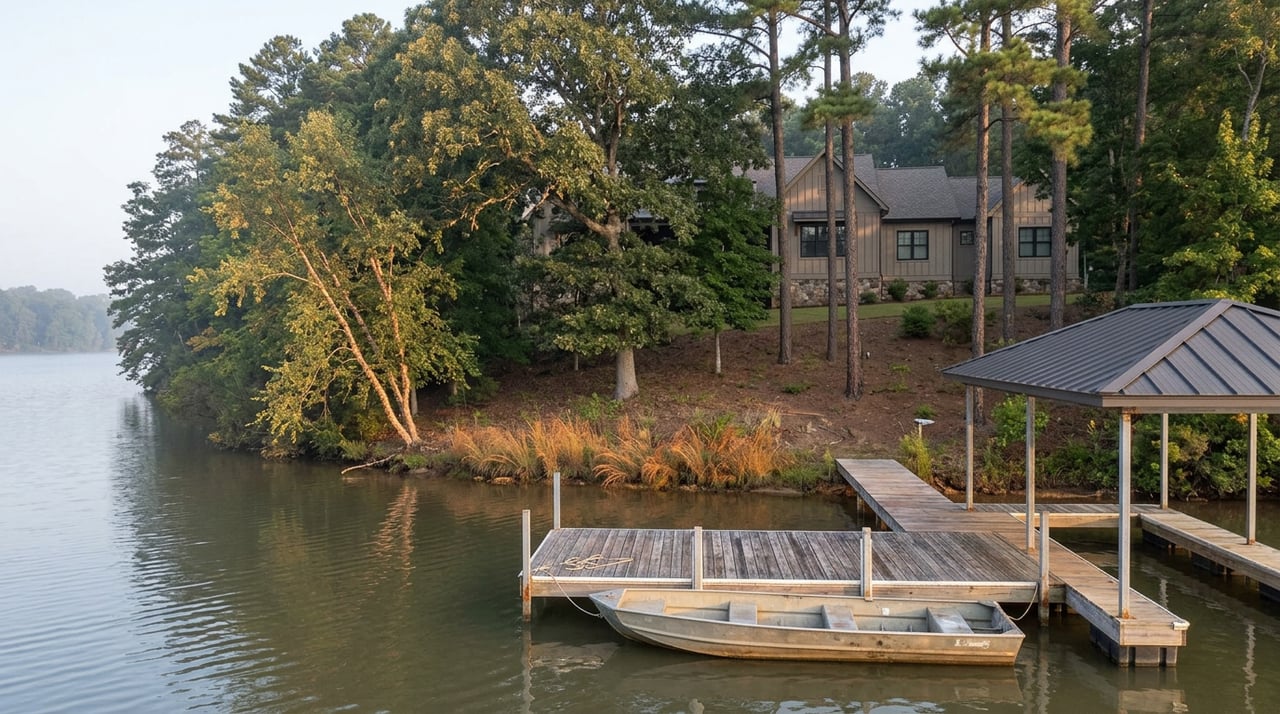
You're standing on a dock that sways gently with the current on Nickajack Lake, coffee in hand, picturing Saturday mornings here. The listing photos sold you on this exact spot. The dock looks solid, well used, clearly not new. In your mind, it's part of the package, the same way the septic system or the driveway is part of the package.
It isn't. Not automatically. And the gap between what you assume and what federal law actually says about that dock is the single most overlooked risk in a Kimball-area waterfront purchase.
Nickajack Lake exists because the Tennessee Valley Authority built Nickajack Dam in 1967, replacing the old Hales Bar Dam from 1913, which had leaked from its foundation for decades. Because TVA built and operates the reservoir, it also regulates almost everything that touches the shoreline under Section 26a of the TVA Act: docks, piers, boathouses, seawalls, rip-rap, even landscaping inside what's called the flowage easement.
Here's the part that catches buyers off guard. A Section 26a permit is issued to a person, not stapled to the deed. When ownership of the property changes, the permit does not travel with the sale the way a survey or a title policy does. The dock you're looking at during your showing was approved for the seller, in the seller's name, based on plans the seller submitted, possibly years ago.
TVA's own buyer and seller guidance is direct on this point: permits do not automatically transfer with property ownership, and the new owner is required to apply for a Section 26a Transfer of Ownership within 60 days of closing. That responsibility sits with you, not with the title company, not with the closing attorney, and not with the seller's agent.
This is easy to miss because nothing about a normal residential closing flags it. You'll walk through inspection contingencies, survey review, and title work. None of that touches a federal permit tied to a structure that technically belongs to a different regulatory conversation. If you don't know to ask, you can close on a Kimball waterfront lot, move in, and have no idea what paperwork applies to the dock.
Sellers sometimes describe an older dock as grandfathered, and sometimes that's true. TVA set November 1, 1999 as the date of its current Shoreline Management Policy. A structure permitted before that date can be grandfathered, but only if it was built exactly to the specifications in that original permit. If a previous owner added a boat lift, enclosed a second story, or extended the walkway without updating the paperwork, that addition is not covered by the old permit, no matter how long it's been there.
And if a structure was never permitted at all, age doesn't fix that. TVA can require removal or modification at the current owner's expense regardless of how many years it's stood. This is worth sitting with for a moment: the dock's history matters less than its paper trail. A well-built, decades-old dock with no permit on file carries more risk than a newer one with clean documentation.
Footprint limits add another layer. Most new water-use facilities on TVA reservoirs are capped at 1,000 square feet. But there's an exception for preexisting development, which applies to subdivisions recorded before November 1, 1999 where TVA had already permitted at least one facility, or to any lot within a quarter mile of a facility TVA permitted before that date.
| Development status | Maximum footprint for docks and water-use facilities |
|---|---|
| New development | 1,000 sq ft |
| Preexisting development (pre-1999 subdivision with at least one TVA-permitted facility, or within a quarter mile of a pre-1999 permitted facility) | 1,800 sq ft |
If you're comparing two Kimball-area lots and one allows nearly double the dock size of the other, this table is usually why.
Waterfront listings around Kimball routinely describe parcels with river frontage, TVA land visible across the water, or building pads positioned above the flood line. One recent Kimball listing offered building pads and an access road already in place, with homesites set above the flood line and protected TVA land running along the opposite shore. Another described two roughly 5-acre lots, each with about 156 feet of Tennessee River frontage, marketed as dockable waterfront acreage.
Language like "dockable" and "waterfront acreage" tells you the lot touches the water. It doesn't tell you whether a dock already sits there, whether that dock has a current 26a permit, or whether TVA owns land or a flowage easement between your future lot line and the actual shoreline. On many Nickajack parcels, TVA does hold land rights along the bank, which means construction in that strip requires separate approval even if you own the upland property outright.
This is why the smart move on a Kimball waterfront lot isn't just checking the survey. It's asking specifically whether TVA land sits between your deed line and the water, because that changes what you can build, repair, or even clear without your own permit application.
Most TVA reservoirs require fixed docks and piers to sit at least 24 inches above full summer pool level. Nickajack is one of five reservoirs, along with Pickwick, Wilson, Wheeler, and Guntersville, where the minimum is lower, at 18 inches above full summer pool.
That six-inch difference matters more than it sounds. A dock built to the more common 24-inch standard on Nickajack is still compliant, since it clears the lower minimum. But if you're evaluating an older structure and the seller or their builder wasn't working from Nickajack-specific plans, it's worth physically checking the deck height against summer pool level rather than assuming a dock that looks fine is dialed in to this reservoir's rule. It's a small detail, but it's the kind of detail that separates a buyer who's done the homework from one who's about to inherit a compliance problem.
A few steps, done before you're under contract, save a lot of stress after closing:
Local dock builders who work this stretch of river regularly, including firms like LMH Waterfront Construction out of Chattanooga, handle TVA permit navigation for waterfront property throughout Jasper, Guild, South Pittsburg, and Kimball, and can be a useful resource if you're trying to sort out what's actually on file for a specific address before you commit.
Buyers evaluating Kimball waterfront property tend to focus on acreage, frontage footage, and distance to Chattanooga. Those numbers matter, but they don't tell you whether the dock in the listing photos is legally yours to use the day after closing. That answer lives in a federal permit file, not in the MLS description, and it's on the buyer, not the seller or the closing table, to chase it down within 60 days.
Does every dock on Nickajack Lake need a TVA permit? Essentially, yes. All construction or alteration to the shoreline on TVA reservoirs requires approval, even minor changes to an existing dock.
The seller says the dock has been there for twenty years without any issue. Does that mean it's fine? Not on its own. Age doesn't grandfather a structure. What matters is whether it was permitted and whether it matches the approved plans on file. Unauthorized structures can still be required to be modified or removed regardless of how long they've stood.
How long does the permit process actually take? A straightforward Transfer of Ownership for an already-compliant, already-permitted dock is generally simpler than starting from scratch. But if you end up needing a new permit, whether because the existing structure isn't compliant or you're planning something new, TVA notes that review can take up to 120 days. Build that into your timeline if a new dock is part of your plan.
Who do I actually call to check a permit? TVA's Public Land Information Center handles permit and land rights questions directly. For the practical side of construction and navigating that process on Nickajack specifically, local waterfront builders who work this river regularly are worth a call before you finalize your offer.
Waterfront property near Kimball has real appeal, and the view from that dock is exactly what it looks like in the photos. Getting the paperwork right just means you get to keep it. If you're weighing a lot on Nickajack Lake and want a second set of eyes on what's actually on file for it, Jessica Wright is happy to help you sort it out before you write the offer, not after. Let's Connect.
This article is general information, not legal, tax or financial advice. Consult a qualified professional about your situation.
Stay up to date on the latest real estate trends.






Let me help you explore your wants and dreams, from finding land to building your dream home to finding a house to make your home. I look forward to being part of that adventure with you.
JESSICA WRIGHT
338 S Cedar Ave
South Pittsburg, TN 37380
OFFICE HOURS
Monday to Saturday: 8:00 AM to 8:00 PM